Морской английский для торгового флота
Навигационные огни и буи
Характеристики огней, дневные признаки и пять основных типов буёв.
Чтобы участники Zoom слышали запись с телефона, включите «Совместный доступ к звуку устройства».
Vocabulary
21 термин с переводом
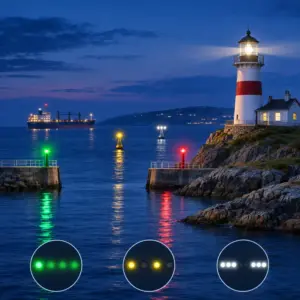 Light characteristicХарактеристика огня
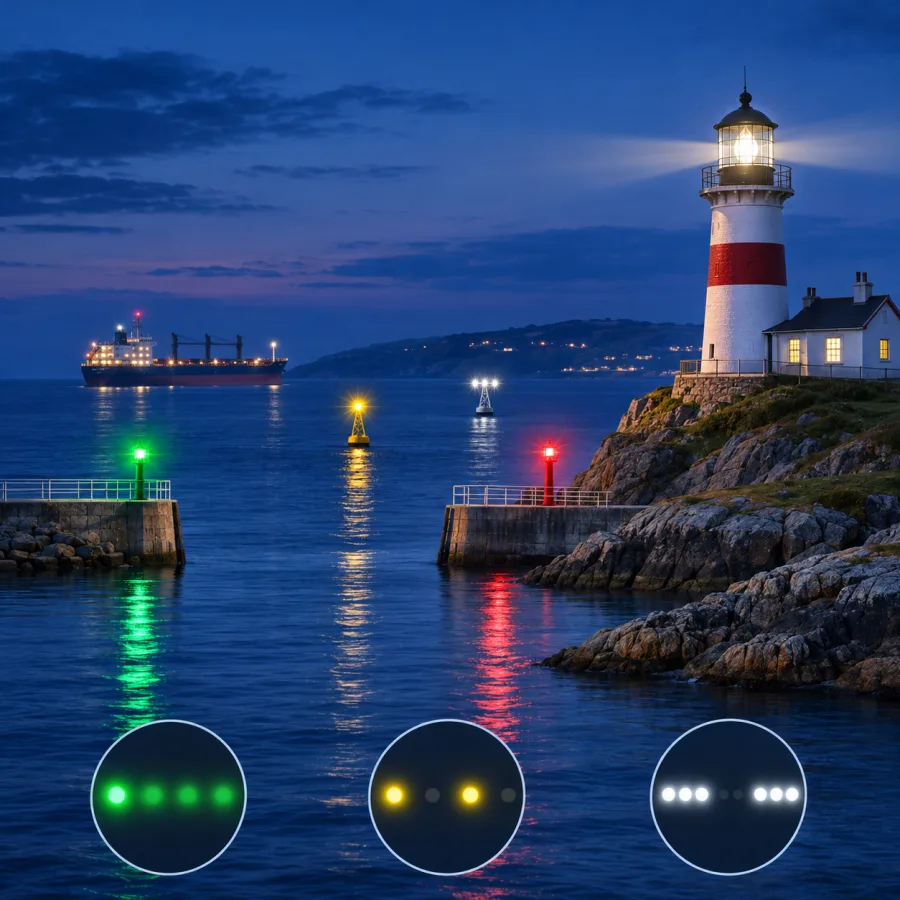
Light characteristic
A light characteristic is the recognizable combination of colour, rhythm and period shown on a chart or light list. The officer identifies the complete pattern rather than relying on a single flash.
 Fixed lightПостоянный огонь
Fixed light
A fixed light shines continuously with steady intensity and no intentional dark interval. Its colour and sector information remain important for identification.
 Flashing lightПроблесковый огонь
Flashing light
A flashing light has periods of light shorter than the periods of darkness. The chart abbreviation and period distinguish it from nearby aids.
 Quick flashingЧастопроблесковый огонь
Quick flashing
A quick-flashing light produces rapid regular flashes, normally at about sixty flashes per minute. It is often associated with cardinal marks and must be counted carefully.
 Very quick flashingОчень частопроблесковый огонь
Very quick flashing
A very-quick light flashes faster than a quick light, normally at about one hundred and twenty flashes per minute. The faster rhythm helps distinguish the mark at night.
 Isophase lightРавнопроблесковый огонь
Isophase light
An isophase light has equal durations of light and darkness within each period. Timing a complete cycle confirms the characteristic.
 Occulting lightЗатмевающийся огонь

Occulting light
An occulting light remains on longer than it is dark. It is the opposite balance from a flashing characteristic.
 Group flashingГрупповой проблесковый огонь
Group flashing
A group-flashing light repeats a stated number of flashes as one group during each period. The number and spacing of flashes are part of the identification.
 Alternating lightПеременный огонь
Alternating light
An alternating light changes between stated colours in a regular sequence. The colours, order and period are read together.
 Morse lightОгонь по азбуке Морзе
Morse light
A Morse light shows short and long flashes that form a specified Morse character. The chart gives the letter and total period.
 Long-flashing lightДлительно-проблесковый огонь
Long-flashing light
A long-flashing light has flashes lasting at least two seconds. Its long bright interval separates it from ordinary flashing lights.
 Lateral markЛатеральный знак
Lateral mark
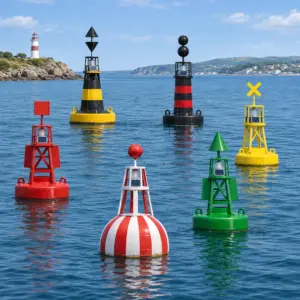
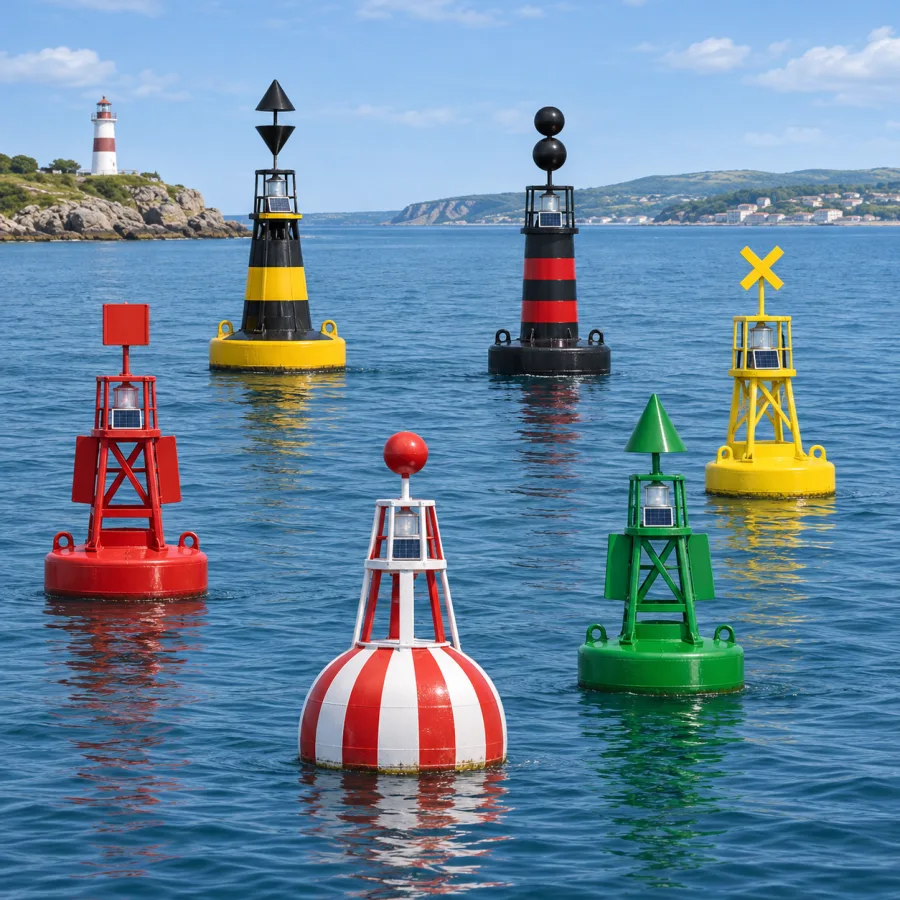
Lateral marks identify the sides of a channel according to the IALA region and direction of buoyage. Their colour, shape, topmark and light must be interpreted with the local system.
 Cardinal markКардинальный знак
Cardinal mark
A cardinal mark shows where safe water lies relative to the mark: north, east, south or west. Black-and-yellow bands, cone topmarks and white-light rhythm work together.
 Isolated danger markЗнак отдельной опасности
Isolated danger mark
An isolated-danger mark is placed on or near a small danger with navigable water around it. It uses black and red bands, two black spheres and a grouped white light.
 Safe water markЗнак безопасных вод
Safe water mark
A safe-water mark indicates navigable water around the mark and may identify a channel centreline, landfall or fairway. It has red-and-white vertical stripes and a red spherical topmark.
 Special markСпециальный знак
Special mark
A special mark identifies an area or feature described on the chart, such as a cable, recreation area or data buoy. It is yellow with an X-shaped topmark and a yellow light that does not conflict with other aids.
 IALA Region AРегион IALA A
IALA Region A
In IALA Region A, red lateral marks identify the port side of a channel when entering from seaward and green marks identify starboard. Mariners confirm the conventional direction of buoyage on the chart.
 IALA Region BРегион IALA B
IALA Region B
In IALA Region B, red lateral marks identify starboard when entering from seaward and green marks identify port. The reversal makes voyage planning and local chart information essential.
 Direction of buoyageНаправление ограждения
Direction of buoyage
The conventional direction of buoyage is generally from seaward into a harbour or as shown by arrows and symbols on the chart. Port and starboard sides are interpreted while following that direction.
 Buoy numberingНумерация буёв
Buoy numbering
Lateral marks may carry numbers or letters that help confirm their sequence and identity. Numbering conventions vary by authority, so the chart and sailing directions are the controlling references.
 TopmarkТоповая фигура
Topmark
A topmark is a distinctive shape mounted above a buoy or beacon for daylight identification. Cones, spheres, cylinders and X-shapes help distinguish lateral, cardinal, danger, safe-water and special marks.
Reading & listening
Navigation Lights and Buoys
Прочитайте или прослушайте текст и выполните три задания.
At night near the entrance to Sydney Harbour, the lookout identifies navigation lights against the bright city background. The harbour opens between North Head and South Head before widening toward the famous bridge and sheltered bays. A green lateral mark confirms one side of the channel, while a cardinal mark warns vessels to pass on its safe side. The officer checks each colour, rhythm and topmark instead of guessing from distance alone. The cadet says flashing buoys look like the sea is decorating a Christmas tree, but he still times every light carefully. Correct identification turns a field of blinking points into a readable map of channels, hazards and other vessels.
Показать перевод
Ночью у входа в Сиднейскую гавань наблюдатель распознаёт навигационные огни на фоне яркого города. Вход проходит между мысами Норт-Хед и Саут-Хед, после чего гавань расширяется к знаменитому мосту и защищённым бухтам. Зелёный латеральный знак подтверждает одну сторону канала, а кардинальный знак указывает, с какой безопасной стороны обойти опасность. Помощник проверяет цвет, ритм и топовую фигуру каждого знака, а не угадывает только по расстоянию. Курсант говорит, что мигающие буи похожи на морскую новогоднюю ёлку, но всё равно внимательно засекает каждый огонь. Правильное распознавание превращает поле мигающих точек в понятную карту фарватеров, опасностей и других судов.
Морской сериал · 60 секунд
Серия: Навигационные огни и буи
Отдельный видеосюжет, который не повторяет текст чтения: слова темы, географический факт и морская шутка. Кадры переходят от утра к дню и ночи.
Субтитры
Morning light reveals lateral buoys along a narrow Norwegian coastal channel. The lookout checks each colour, topmark, rhythm, and safe-water direction. Norway’s long coast is protected by islands, skerries, and deep fjords. At midday, a cardinal mark directs the vessel away from a hidden rock. The cadet says flashing buoys are the sea practising for a Christmas party. At night, timed lights turn the dark channel into a readable safety map.
Перевод
Утренний свет показывает боковые буи вдоль узкого норвежского прибрежного канала. Наблюдатель проверяет каждый цвет, топовую марку, ритм и направление безопасной воды. Длинное побережье Норвегии защищено островами, шхерами и глубокими фьордами. В полдень кардинальный знак направляет судно от скрытой скалы. Курсант говорит, что мигающие буи — это море, готовящееся к рождественской вечеринке. Ночью синхронизированное освещение превращает темный канал в удобочитаемую карту безопасности.
Tasks